

Beyond the C-Rating: Why Your Battery Connection Matters

Why Team Exalt Is Introducing 6mm Battery Connections to the Game!
Understanding 5mm vs. 6mm Bullets and Why High-Amperage RC Racing Is Changing
At Team Exalt, we believe product development should follow what is actually happening at the racetrack.
Over the years, we’ve watched 1/8-scale electric racing change dramatically. Cars have become more efficient and capable. ESCs have become more powerful. Motors have improved. Batteries can deliver greater output. Tire technology and suspension development have improved. Tracks have evolved, and today’s drivers are able to put more power to the ground than ever before.
All of those improvements have one thing in common:
They continue to place greater demands on the electrical system.
For years, the 5mm bullet connector has served RC racing extremely well, and we want to make something clear from the beginning:
There is nothing inherently wrong with a quality 5mm bullet connection.
Team Exalt has successfully used 5mm connections throughout our battery lineup, and we will continue to offer batteries where a 5mm connection makes sense.
However, there comes a point where continually increasing the demands placed on a component means we need to reevaluate that component.
We believe we’re reaching that point in certain high-amperage RC applications.
That’s why Team Exalt has elected to begin introducing 6mm bullet connections into portions of our X-Rated battery lineup, starting with the new EXA3219 X-Rated 8800mAh 195C 7.4V Stick Battery.
This isn’t about saying bigger is automatically better.
It’s about understanding current, resistance, heat, contact area, connector condition, and how today’s RC vehicles are actually being used.
Let’s explain why.
The RC Car Has Changed — So Has the Electrical Load
If we compare today’s high-level 1/8 electric racing to what racers were asking from their equipment years ago, there are significant differences.
The entire vehicle has evolved.
Modern ESCs can deliver tremendous power.
Modern batteries have improved tremendously.
Motor technology has continued to advance.
Tires and inserts have improved.
Suspension systems have become more refined.
Tracks can provide tremendous traction.
Drivers have become better at using that available traction.
Vehicles are being accelerated harder and driven more aggressively.
All of that affects the electrical system.
When a vehicle has more traction, the motor can place more load on the battery.
When a heavier vehicle accelerates harder, current demand can increase.
When larger rotating masses are accelerated, the electrical system works harder.
When a racer lands a jump and immediately goes back to throttle, the power system experiences another demanding transient load.
When gearing, motor selection, ESC settings, vehicle weight, tire diameter, and traction are combined, the current demands placed on a modern RC battery system can become substantial.
The battery connector has to carry all of it.
The Connector Is Part of the Power System
Racers naturally focus on the major components:
Battery.
ESC.
Motor.
But electrically, those components don’t operate independently.
The power has to travel through a complete circuit.
A simplified power path looks like this:
Battery → Bullet Connection → Wire → ESC → Motor
The battery connector isn’t just something that holds the wires together.
It is a high-current electrical connection.
Every amp demanded by the power system has to travel through it.
That means the connector has resistance.
The wire has resistance.
The solder joints have resistance.
The battery itself has internal resistance.
Every connection in the system contributes something.
Our goal is to keep those resistances as low as practically possible.
Why Does Resistance Matter?
Two of the most important consequences of electrical resistance in an RC power system are:
Voltage Drop
and
Heat.
Neither one is desirable.
Voltage lost across a connection isn’t available to the ESC.
Electrical energy converted into heat at the connector isn’t helping propel the car.
This becomes especially important because of how resistance behaves as current increases.
The Most Important Equation in This Discussion: I²R
Heat generated by electrical resistance can be described by:
P = I²R
Where:
P = Power converted to heat
I = Current flowing through the connection
R = Resistance of the connection
Here’s the part racers need to understand:
Current is squared.
That means if the resistance remains exactly the same but current doubles, the heat generated at that resistance point increases by four times.
Let’s use an educational example.
Suppose we have a connection with just:
1 milliohm of resistance — 0.001Ω.
At 50 amps:
2.5 watts of heat
At 100 amps:
10 watts of heat
At 150 amps:
22.5 watts of heat
At 200 amps:
40 watts of heat
These numbers are not measurements of a 5mm connector. They’re simply an illustration of the physics.
But they demonstrate exactly why we’re having this conversation.
The resistance didn’t change.
The current did.
And that dramatically changed the amount of heat generated.
What We’ve Seen at the Racetrack
This decision isn’t based solely on theory.
It’s also based on what we’ve seen racers experience over years of racing, product support, and working with high-performance electronics.
We’ve seen batteries come back with:
Heat damage around the bullet connection
Melted areas around the battery terminal
Discolored connectors
Damaged cases
Burned or pitted bullets
Connections that have lost tension
And in many cases, the battery cells themselves were not necessarily where the problem originated.
The heat was concentrated around the connection.
There are multiple reasons this can happen.
Sometimes it’s user error.
Sometimes the connector wasn’t fully seated.
Sometimes the bullet has become worn.
Sometimes a connector has lost tension.
Sometimes dirt or contamination has entered the connection.
Sometimes there is a poor solder joint.
Sometimes the mating bullet is damaged.
Sometimes an adapter or jumper introduces another poor connection.
And sometimes we’re simply asking a connector to carry increasingly demanding current loads.
Usually, it isn’t one universal cause.
That’s exactly the point.
The connection is a variable in the system, and as amperage increases, problems at that connection become increasingly unforgiving.
A Small Connection Problem Becomes a Big Heat Problem
Imagine a connector is perfect when it’s new.
After dozens or hundreds of cycles of plugging and unplugging it, the fit may begin to change.
Now add dirt.
Add vibration.
Add heat cycles.
Add crashes.
Add wear.
Maybe the mating connector isn’t exactly the same quality.
Maybe the bullet isn’t inserted completely.
The connection may still “work.”
The car turns on.
The ESC initializes.
The vehicle drives.
But electrically, the connection may no longer be performing the same way it did when everything was new.
If resistance increases even slightly, high current magnifies the effect.
That’s where racers can get into trouble.
The Car Can Still Run While a Connector Is Creating Heat
This is something racers need to understand.
A bad connection doesn’t necessarily mean:
ON or OFF.
There is a large area between a perfect electrical connection and a completely failed connection.
A compromised connector can still conduct electricity.
The car can still run.
The driver may not immediately notice anything unusual.
But additional resistance can be converting electrical energy into heat every time substantial current passes through that connection.
Run after run, that heat can damage:
The bullet
The battery case
The surrounding plastic
The solder connection
The mating connector
Eventually, the damage becomes visible.
But the electrical problem may have started much earlier.

Why Have 5mm Bullets Worked for So Long?
Because 5mm bullets are good connectors.
We don’t want this article to imply otherwise.
A properly designed, high-quality 5mm bullet with excellent contact pressure can provide a very good electrical connection.
That’s why they’ve been successful in RC racing.
They’re compact.
They’re lightweight.
They’re widely available.
They’re easy to package.
They’re proven.
And in many applications, they provide more than enough capability.
The issue isn’t that 5mm suddenly stopped working.
The issue is that the application surrounding the connector continues to evolve.
We’re Asking More From the Same Connection
This is really the heart of Team Exalt’s decision.
Think about how many components have advanced.
We’re asking batteries to deliver more.
We’re asking ESCs to control more power.
We’re asking motors to produce more performance.
We’re putting more traction into the vehicle.
We’re improving drivetrain efficiency.
We’re improving tires.
We’re improving chassis.
We’re improving suspension.
We’re improving driver capability.
We’re increasing the ability of the vehicle to put power into the track.
But we’re still asking the same physical battery connection to transfer all of that current.
At some point, it makes sense to add additional electrical headroom.
For Team Exalt, moving certain high-current batteries from 5mm to 6mm is part of that evolution.
So What Does Going From 5mm to 6mm Actually Change?
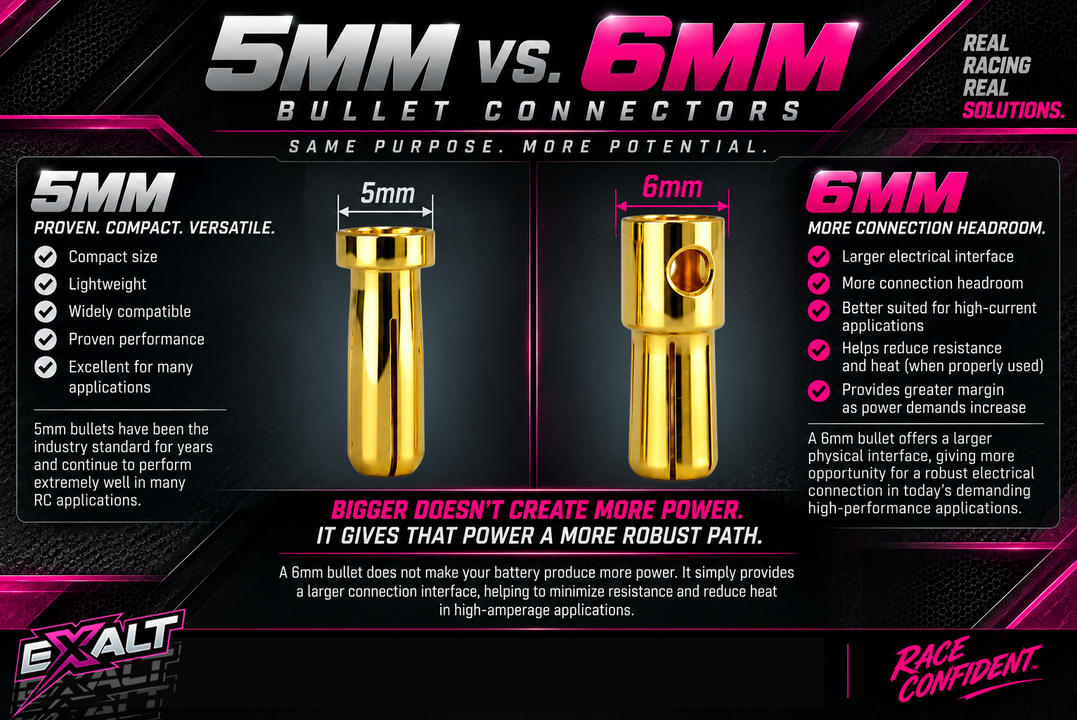
A 6mm bullet is physically larger in diameter than a 5mm bullet.
Diameter alone doesn’t determine the quality of a connector.
That’s important.
Connector performance also depends on:
Connector material
Plating
Contact design
Contact pressure
Mechanical fit
Surface condition
Temperature
Solder quality
Wire size
Wear
Contamination
But all else being properly engineered, increasing connector size gives us a larger physical interface to work with.
That provides additional opportunity for robust electrical contact in high-current applications.

Contact Area Matters
Electricity needs a conductive path.
The actual electrical performance of a bullet connection depends heavily on the quality and area of the surfaces actually making contact.
A larger connector provides more physical surface area available for that connection.
That does not mean every 6mm connector automatically has lower resistance than every 5mm connector.
A poor-quality 6mm connector can absolutely perform worse than a high-quality 5mm connector.
Quality still matters.
But when both are properly designed, properly fitted, clean, and in good condition, the larger connector gives us additional physical and electrical headroom for demanding applications.
That’s what we’re after.
Why Lower Connection Resistance Is Valuable
Remember:
Voltage Drop = Current × Resistance
and:
Heat = Current² × Resistance
If we can reduce connection resistance, we can reduce both:
Voltage loss
and
Heat generation
for a given current.
That becomes more important as current increases.
And that’s exactly what is happening in modern high-performance RC racing.
Does a 6mm Bullet Make the Car Faster?
Not by itself.
And we think manufacturers need to be careful about making claims like that.
A 6mm bullet does not create energy.
It doesn’t change an 8800mAh battery into a higher-capacity battery.
It doesn’t make your motor produce power from nowhere.
What we’re doing is trying to improve the pathway through which the available power travels.
Think of the electrical system as a highway.
The battery has the energy.
The motor wants the energy.
The ESC controls the delivery.
The connection is part of the road between them.
Our goal isn’t to create more cars.
It’s to reduce the possibility of creating a traffic jam.
The Advantages of 5mm Bullets
We still believe 5mm has a place in RC racing.
Compact
They’re easy to package into smaller battery cases and vehicles.
Lightweight
There’s less material compared with a larger connection.
Widely Compatible
There is a huge existing ecosystem of 5mm charge leads, ESC leads, batteries, and accessories.
Proven
Thousands upon thousands of racers have successfully used 5mm connections.
Excellent for Appropriate Current Levels
Not every application requires a larger connector.
For many applications, 5mm remains an excellent choice.
The Potential Limitations of 5mm in Extreme Applications
The issue begins when current demand continues increasing.
A smaller connection has less physical area available than a larger connection.
That means things like:
Connector tension
Wear
Contamination
Fit
Insertion depth
and
Surface condition
can become increasingly important.
And as we already established:
Higher current magnifies resistance-related heat.
This is why we’re not abandoning 5mm.
We’re simply recognizing that some applications have reached a point where we want more connection headroom.
The Advantages of Moving to 6mm
1. Larger Physical Connection
A 6mm bullet provides a larger physical interface between the battery and mating connector.
2. More Electrical Headroom
This is particularly important as current demand increases.
We’re designing not only around what yesterday’s vehicles required, but what today’s and tomorrow’s vehicles may demand.
3. Opportunity for Lower Connection Resistance
With a quality, properly fitted connector, the larger interface helps us build a robust high-current electrical connection.
4. Reduced Potential for Resistive Heating
Lower resistance means less heat generated for a given current.
In high-current applications, even relatively small improvements become increasingly valuable.
5. Reduced Voltage Drop
Lower resistance also means less voltage is lost across the connection under load.
6. Greater Margin for High-Amperage Applications
This is really what we’re after.
Margin.
We don’t want the battery connector operating near the edge of what we’re comfortable asking from it.
Are There Disadvantages to 6mm?
Yes.
Engineering is always about tradeoffs.
Size
A 6mm connection takes up slightly more physical space.
Weight
There is slightly more material.
Compatibility
Racers who already own 5mm ESC leads and charge leads may need to update their equipment.
Cost and Convenience
Changing connector standards isn’t necessarily convenient.
We understand that.
That’s exactly why Team Exalt isn’t saying:
“Everything needs to become 6mm tomorrow.”
We’re taking a targeted approach.
We’re starting to introduce 6mm where we believe the application justifies it.
Why Start With the EXA3219 8800mAh Stick?
The first battery where we’re implementing this direction is the:
Team Exalt X-Rated EXA3219
8800mAh
7.4V
195C
270C Max Burst
332g +/-
139mm × 47mm × 25.1mm
6.0mm Bullet
We chose this battery intentionally.
The high-capacity stick format is well suited to applications where racers are asking a lot from their electrical systems.
It’s also part of a larger discussion about battery configurations in modern 1/8 vehicles.
Single Packs vs. Multiple-Pack Configurations
Modern 1/8 platforms can offer different battery layouts.
Some vehicles accommodate a larger single battery.
Others can use configurations involving multiple packs.
For example, two compatible 2S batteries can be connected in series to create a 4S system.
Electrically, that introduces another important consideration:
More connections.
A simplified single-pack system may have:
Battery → ESC
A dual-pack system may involve:
Battery #1 → Series Jumper → Battery #2 → ESC
The dual-pack arrangement isn’t inherently bad.
But every additional:
Bullet connector
Jumper
Solder joint
Wire
Contact point
is another potential location for resistance.
Why Fewer Connections Can Be Beneficial
In electrical design, simplicity has value.
If you can accomplish the same job with fewer high-current connections, you’ve reduced the number of potential problem areas.
That means fewer connections that can:
Wear
Loosen
Get dirty
Be installed incorrectly
Develop excessive resistance
Generate heat
Again, that doesn’t mean a dual-battery configuration is unsafe or inferior.
It simply means racers using those systems need to be particularly aware of connection quality because there are more connections carrying high current.
User Error Is a Real Part of the Equation
We want to discuss this without blaming racers.
RC racing happens in the real world.
People are rushing between rounds.
They’re changing batteries.
They’re helping other racers.
They’re working in dusty pits.
They’re charging multiple packs.
They’re repairing cars after crashes.
Things happen.
A bullet may not get pushed completely into the battery.
A connector may have been damaged without the racer realizing it.
A jumper may be worn.
A bullet may have lost tension.
A connector may be contaminated.
An adapter may introduce another resistance point.
The system needs to be designed with the real racing environment in mind.
Providing more connection headroom is one way we can help.
Connector Fit Is Extremely Important
Whether you’re running 5mm or 6mm:
The connector needs to fit properly.
A loose bullet connection can reduce the effective contact between the mating surfaces.
Less effective contact can mean increased resistance.
Increased resistance under high current means more heat.
If a bullet suddenly feels noticeably easier to insert than it used to, inspect it.
If it feels loose, investigate.
If the connector wiggles excessively, investigate.
If you’re seeing discoloration, investigate.
Don’t assume that because the car powers on, the connection is healthy.
Fully Seat Your Connectors
This sounds incredibly simple, but it matters.
A bullet connector is designed to make electrical contact across its intended mating surface.
If it isn’t fully seated, you may not be utilizing the complete connection as intended.
Make it part of your pre-run routine.
Check your battery connections before the vehicle hits the track.
Inspect for Heat After a Run
Heat is one of the best clues racers have.
After a demanding run, pay attention to the system.
If everything is warm but one bullet connector is dramatically hotter than the surrounding components, that deserves attention.
If one side of the battery connection is hot and the other isn’t, ask why.
If the wire is relatively cool but the connector is extremely hot, ask why.
If the jumper between two packs is extremely hot, ask why.
Localized heat can be a sign of localized resistance.
Don’t simply keep running until something melts.
Don’t Ignore Discoloration
Discoloration can be an early warning.
Look for:
Dark spots
Burn marks
Pitting
Surface damage
Melted plastic
Changes in plating
Signs of arcing
These are all reasons to inspect the connection carefully.
Clean Connections Matter
Off-road RC racing is not a clean environment.
Dust, dirt, and debris get everywhere.
Electrical contact surfaces should remain clean.
Contamination between mating surfaces can interfere with the quality of the connection.
Inspect and maintain your connectors just like you maintain:
Bearings
Differentials
Shocks
Drivetrain components
The electrical system deserves the same attention.
Wire Gauge Matters Too
A 6mm bullet isn’t a magic fix for an electrical system with another bottleneck.
The entire current path needs to make sense.
Battery → Bullet → Wire → ESC
If the connector is excellent but the wiring introduces unnecessary resistance, you’ve simply moved the restriction somewhere else.
High-current systems should use appropriately sized quality wire and quality connections throughout.
Solder Joints Are Part of the Connection
Racers often spend significant money on batteries, motors, and ESCs, then overlook the quality of a solder joint.
That’s a mistake.
A poor solder joint can introduce additional resistance.
In a high-current system, that resistance can create heat.
Proper preparation, adequate heat, appropriate soldering technique, and a solid mechanical/electrical joint all matter.
Avoid Unnecessary Adapters and Connections
Adapters are convenient.
Sometimes they’re necessary.
But every adapter potentially adds:
Another connector
Another solder joint
More wire
Another contact surface
When we’re designing a dedicated high-current race system, we prefer to keep the electrical path as direct as practical.
Fewer unnecessary connections means fewer opportunities for resistance.
Drivers and Tracks Are Part of This Evolution Too
It’s easy to say electronics are becoming more powerful.
But that isn’t the whole story.
Racers themselves are evolving.
Driving standards continue to improve.
The best drivers are incredibly good at using available traction and carrying speed.
They’re able to get back into the throttle sooner and harder.
Tracks are evolving too.
Surface preparation has improved.
Tire technology has improved.
Traction compounds and track conditions can create tremendous grip.
Chassis development allows vehicles to utilize that grip.
When the tire hooks up instead of spinning, the motor has to work harder to accelerate the vehicle.
More usable traction can mean more load on the electrical system.
That’s part of why we’re seeing demands today that weren’t necessarily as significant years ago.
Bigger Tires and Rotating Mass Matter
This is especially relevant to E-Truggy.
Large tires have more rotating inertia than smaller tires.
Accelerating that rotating mass requires energy.
Combine:
Large tires
Vehicle weight
High traction
Powerful motors
Aggressive driving
and you can create a very demanding electrical environment.
This is exactly the type of application where Team Exalt sees additional value in a larger high-current connection.
What 6mm Does NOT Do
We want racers to understand this clearly.
A 6mm connector does not automatically:
Increase battery capacity
Increase motor KV
Fix bad gearing
Fix excessive motor temperature
Fix an undersized wire
Fix a poor solder joint
Fix a loose connector
Fix a damaged battery
It is one component in the complete electrical system.
The benefit is providing a larger, more robust connection interface with additional headroom for demanding current loads.
Why Team Exalt Is Making the Change
This isn’t a reaction to one race.
It isn’t because 6 is a bigger number than 5.
And it isn’t because we’re trying to convince racers that every 5mm connector is suddenly inadequate.
This comes from watching the evolution of RC racing.
We’ve watched batteries improve.
We’ve watched ESCs improve.
We’ve watched motors improve.
We’ve watched vehicles improve.
We’ve watched tires improve.
We’ve watched tracks develop more traction.
We’ve watched drivers become capable of using more of the available power.
And we’ve watched racers occasionally damage batteries around the bullet connection because of poor connections, connector wear, installation mistakes, contamination, user error, and increasing current demand under load.
At some point, product development needs to respond to what we’re seeing.
We believe this is that point.
For high-amperage applications, Team Exalt wants additional connection headroom.
That’s why we’re beginning to incorporate 6mm bullets into our battery lineup.
We’re Not Eliminating 5mm
This is an important distinction.
Team Exalt is not saying that every battery needs a 6mm connector.
We’ll continue evaluating connector size based on the application.
For many applications, 5mm remains an excellent choice.
But when we’re designing batteries intended for particularly demanding high-current use, we believe 6mm gives us advantages worth incorporating.
The EXA3219 8800mAh 195C is the beginning of that direction.
What Racers Should Take Away From This
Whether you’re using 5mm or 6mm, start thinking about your battery connection as a performance component.
Not just a plug.
Inspect it.
Maintain it.
Keep it clean.
Make sure it fits properly.
Fully seat it.
Watch for discoloration.
Check for unusual heat.
Inspect your solder joints.
Use appropriate wire.
Minimize unnecessary adapters.
And don’t continue using a damaged connection simply because the car still turns on.
As current increases, the details matter more.
The Next Step for Team Exalt X-Rated Batteries
The new EXA3219 X-Rated 8800mAh 195C is our first step toward adding 6mm connectivity to applications where we believe racers can benefit from the additional electrical headroom.
EXA3219 Specifications
Capacity: 8800mAh
Voltage: 7.4V
Discharge Rate: 195C
Maximum Burst Discharge Rate: 270C
Weight: 332g +/-
Dimensions: 139mm × 47mm × 25.1mm
Connector: 6.0mm Bullet
But the bigger story isn’t one battery.
It’s the evolution of the RC power system.
Cars are getting better.
Electronics are getting better.
Tracks are getting faster.
Traction is increasing.
Drivers are asking more from their equipment.
And current demand under load continues to challenge every component responsible for delivering power.
At Team Exalt, we believe the battery connection needs to evolve with the rest of the vehicle.
5mm has served RC racing extremely well and will continue to do so in the right applications.
For the applications where we’re asking more from the electrical system, however, we believe it’s time to provide more connection headroom.
That’s why Team Exalt is beginning the move toward 6mm.
Not because bigger automatically means faster.
Not because 5mm suddenly stopped working.
Because the cars, tracks, drivers, batteries, motors, ESCs — and the electrical demands we’re placing on them — have evolved.
And our products need to evolve with them.
TEAM EXALT
Evolving the Connection to Meet the Demand.
Inside Exalt
-

Beyond the C-Rating: Why Your Battery Connection Matters
Sep 9th 2026Why Team Exalt Is Introducing 6mm Battery Connections to the Game! Understanding 5mm vs. 6mm Bull
-

Why Lead-Free Solder is the Future of RC Performance
Aug 26th 2025By Team Exalt Tech Blog For decades, most RC racers have used 60/40 leaded solder (60% tin, 40% le
-
